
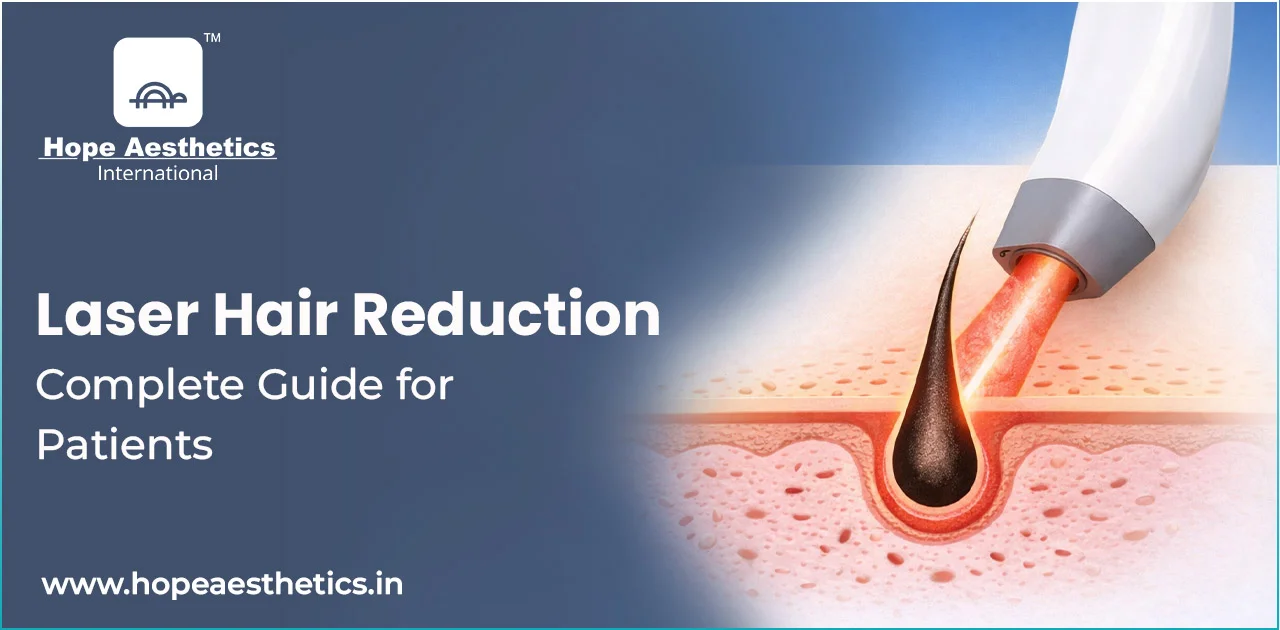
Laser Hair Reduction – Complete Guide for Patients
Introduction
Unwanted hair is a long-standing aesthetic concern affecting both men and women.
Traditional methods such as shaving, waxing, threading, and depilatory creams provide temporary relief but fail to address the root cause – the hair follicle. Laser Hair Reduction
(LHR) is a medical-grade technology designed to reduce hair growth at the follicular level, offering long-term reduction rather than short-term removal.
This article Hope Aesthetics Clinic explains Laser Hair Reduction in simple, patient-friendly language — covering science, procedure, safety, expectations, myths, and aftercare.
1. What Is Laser Hair Reduction?
Laser Hair Reduction is a non-invasive dermatological procedure that uses focused light energy to target and damage hair follicles, reducing their ability to regrow hair.
Key clarification:
- It is called hair reduction, not permanent hair removal.
- The goal is thinner, lighter, slower regrowth, not 100% eradication.
2. How Laser Works (Scientific Mechanism Simplified)
Laser targets a pigment called melanin, present in hair shafts.
Process:
- Laser emits a specific wavelength of light.
- Melanin absorbs this light energy.
- Energy converts into heat.
- Heat damages the follicle bulb and stem cells.
- Future hair growth becomes weaker or stops.
Important:
- Works best on dark hair + light skin (high contrast).
- Less effective on white, grey, blonde, or red hair due to low melanin.
3. Hair Growth Cycle & Why Multiple Sessions Are Needed
Hair grows in 3 phases:
| Phase | Description | Laser Effectiveness |
| Anagen | Active growth phase | Most effective |
| Catagen | Transition phase | Limited effect |
| Telogen | Resting phase | Ineffective |
At any time, only 15–25% hair is in Anagen phase. Hence:
- Multiple sessions are required.
- Sessions are spaced 4–6 weeks (face) or 6–8 weeks (body).
Average requirement: 6–8 sessions for visible reduction.
4. Areas That Can Be Treated
Women
Face (upper lip, chin, sideburns)
- Underarms
- ArmsLegsBikini line
- Full body
Men
- Beard shaping
- Neck line
- ChestBackShoulders
- Abdomen
5. Types of Laser Technologies
Different machines use different wavelengths.
| Laser Type | Wavelength | Best For |
| Diode | 800–810 nm | Indian skin (most common) |
| Alexandrite | 755 nm | Light skin |
| Nd:YAG | 1064 nm | Dark skin |
| IPL* | Broad spectrum | Less precise |
*IPL is not a true laser — it’s light-based and less effective.
For Indian skin types (IV–V), Diode and Nd:YAG are safest.
6. Step-by-Step Procedure
1. Consultation
- Skin type assessment
- Hair thickness evaluation
- Medical history review
2. Pre-Procedure Prep
- Area shaved (not waxed)
- Skin cleaned
- Cooling gel applied (if required)
3. Laser Application
- Handpiece delivers pulses
- Sensation: mild heat / rubber band snap
4. Post-Laser Cooling
- Ice packs / cooling device
- Soothing gel / sunscreen
Session time: - Upper lip: 5 min
- Underarms: 10 min
- Full body: 2–3 hrs
7. Who Is an Ideal Candidate?
Best results seen in:
- Dark, coarse hair
- Light to medium skin
- Hormonal hair (PCOS) – requires maintenance
- Ingrown hair sufferers
- Folliculitis / razor bumps
8. Who Should Avoid or Delay?
Temporary contraindications:
- Active skin infections
- Open wounds
- Sunburn / tanning
- Pregnancy (relative precaution)
Medical clearance needed in: - Epilepsy (light-triggered)
- Keloid tendency
- Photosensitive disorders
4. Pre-Treatment Guidelines
Do:
- Shave 24 hrs prior
- Use sunscreen
- Keep skin clean
Avoid:
- Waxing/threading (4 weeks)
- Tanning (2 weeks)
- Retinol/peels (5–7 days)
Reason: Follicle root must be present for laser targeting.
10. Post-Treatment Care
Normal reactions:
- Mild redness
- Perifollicular swelling
- Warm sensation
Care instructions:
- Ice application
- Aloe vera gel
- Broad-spectrum sunscreen
- Avoid gym/heat 24 hrs
- No waxing between sessions
Hair shedding occurs in 7–14 days — this is normal.
11. Side Effects & Safety
When done medically, side effects are minimal.
Possible risks:
| Side Effect | Cause |
| Burns | Wrong settings |
| Hyperpigmentation | Sun exposure |
| Blisters | Excess heat |
| Paradoxical growth | Rare hormonal response |
Risk is highest in:
- Cheap clinics
- Untrained operators
- IPL misuse
14. Laser vs Traditional Methods
| Method | Duration | Skin Damage | Ingrown Risk |
| Shaving | 2–3 days | Low | High |
| Waxing | 3–4 weeks | Moderate | Moderate |
| Creams | 2–3 weeks | Chemical irritation | Moderate |
| Laser | Long-term | Minimal | Very low |
15. Cost Factors
Pricing depends on:
- Area size
- Hair density
- Machine type
- Clinic expertise
- City/location
Cheap packages often compromise on:
- Energy settings
- Hygiene
- Machine quality
- Technician training
14. Common Myths vs Facts
Myth: Laser removes hair permanently
Fact: It reduces and thins hair long-term
Myth: One session is enough
Fact: Requires 6–8 sessions
Myth: Laser causes cancer
Fact: Laser targets surface follicles, not DNA
Myth: It increases hair growth
Fact: Only rare paradoxical stimulation cases
Myth: Home devices equal clinic lasers
Fact: Medical lasers are far more powerful
17. Hormones & Laser Hair Reduction
Conditions like:
- PCOS
- Thyroid disorders
- Androgen excess
These cause continuous follicle stimulation.
Laser still works – but requires:
- More sessions
- Maintenance sittings
- Medical management
18. Benefits Beyond Hair Reduction
Patients often notice:
- Smoother skin
- Reduced pigmentation
- Fewer ingrown hair
- Reduced body odor (underarms)
- Even skin tone
19. Is Laser Hair Reduction Permanent?
Reality:
- 80–90% long-term reduction achievable
- Remaining hair becomes:
- Thinner
- Lighter
- Slower growing
Maintenance keeps skin near hair-free.
20. Final Patient Guidance
Laser Hair Reduction is a medical procedure, not a salon service.
Outcome depends on:
- Machine quality
- Doctor supervision
- Correct parameters
- Patient compliance
- Hormonal profile
Choosing clinics based only on price often leads to:
- Burns
- Poor results
- Increased sessions
- Higher long-term cost